On Befriending Kids


Kids don't want to make polite conversation. Here's what they want to talk about instead.
There’s a nine year old in my life who I only see occasionally because he and his family live in another state. He’s historically had approximately zero interest in grownups, and clearly doesn’t enjoy answering polite questions about how he likes school. He just wants to play baseball and do taekwondo and swarm around the neighborhood with his friends. Yet he and I are tight: I am a kid whisperer.
I’m proud of this skill because it can be hard to build and maintain relationships with the kids in our lives. The younger the child, the longer any interval of absence must seem to them: for a one year old, three months is a full quarter of their life. That’s the equivalent of me, at 44, not seeing someone for eleven years. When kids are little, you basically have to reintroduce yourself every time. Then there’s the impact of distance: according to the Auntie Bulletin Reader Survey, nearly half of this newsletter’s readers have to get on a plane to see the important kids in our lives. So we may go a year or two or more between visits with the kids we love – and in that time, they’ve pretty much forgotten us.
This means that maintaining kinship ties can require a lot of befriending and re-befriending the children we love. Through nearly thirty years of Auntiehood, plus a lot of years of studying child development as a teacher and education researcher, I’ve gotten good at making connections with kids, and today I’m going to share some things I’ve learned. (I’m focusing on pre-teens, but parts will be relevant to teenagers as well).

Make conversation easy and interesting for kids.
Adults often make the mistake of asking children polite, open-ended questions about their lives. “How do you like school?” “What do you want to be when you grow up?” “Did you have fun at gymnastics?” Most kids are capable of having these conversations, but they’re rarely interested in having them with strangers. This is essentially small talk, and small talk requires a willingness to pay attention to someone you hardly know talking about a topic you may not really care about. Kids are rarely up for that.
Fortunately, you can make conversation easier on them by going first, and offering (interesting!) information. In the world of education, we call this lightening the cognitive load. Making your own contribution at the outset lets a kid get a feel for what you’re all about, while also supplying specific content for them to respond to.
- Instead of “How do you like school?” tell them in a sentence or two about a silly teacher you had, a surprising playground incident you witnessed, or a kid you knew who could do a cool trick.
- Instead of “What do you want to be when you grow up?” tell them what you wanted to be when you grew up, and maybe what your friends wanted to be, too.
Another way to lighten the load on kids is to ask what amounts to a multiple choice question. Multiple choice questions are common on tests and surveys of all kinds because they require less effort, so people are more likely to answer them. This format is also nice because it gives you an opportunity to throw in a silly option.
- Instead of “Did you have fun at gymnastics?” try “Did you love gymnastics today or hate it?” or “Which do you like better, gymnastics or drawing? Or sitting silently in the dark doing nothing?”
- Instead of “What’s your favorite food?” you could ask, “Which food do you like best: pizza, ramen, or fish guts?”
One of the most successful conversation gambits with kids, I’ve found, is to actually not expect them to respond at all. Just lob one or two kid-friendly observations in their direction and see what happens.
- “On my way here I saw a tractor with the most gigantic tires I have ever seen! They were bigger than my car! I was like, ‘whaaaat????’”
- “Look at that, we both have boots. But yours have stripes and mine have no stripes. No fair! I want stripes on my boots! Maybe we should trade.”
- “I see you’ve got a Pokémon binder there. Believe it or not, I know nothing about Pokémon! The only one I can even name is Pikachu!”[[1]]
Whether the kid responds or not, after your first foray, walk away and give them some space to decide what they think of you. In a little while, mention another topic they might be interested in. Wait for them to come to you. Chances are, pretty soon they’ll run up with something they want to say. When that happens, chat away! Just be ready for them to scamper off again pretty quickly, possibly in the middle of a sentence.
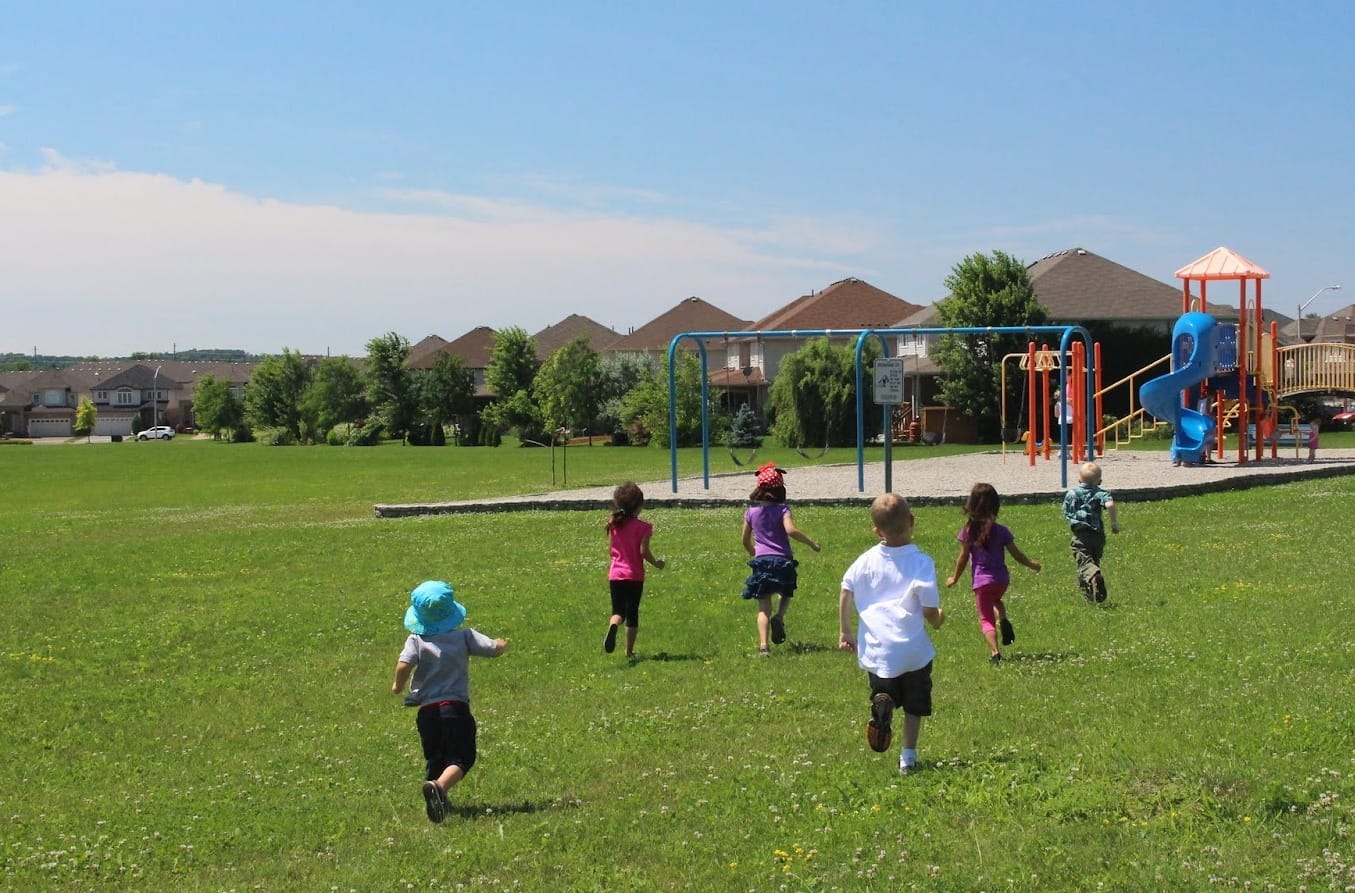
As you get acquainted, pay attention to the kid.
Adults who aren’t confident with children often spend their whole time around kids talking to the grownups. This may seem obvious, but I know a number of parents who wish their own parents (that is, their kids’ grandparents) would actually interact with their children. Sometimes adults don’t interact with kids because they’re not really interested or don’t like kids. Fair enough – not Auntie material.
In other cases, though, adults don’t interact with kids because they don’t know what to say (in which case, see above) or just aren’t used to it. If that’s you, you can cultivate the skill of paying intermittent attention to what the kids are doing. If they’re doing something cool, mirror that back to them and convey your legit respect. Say, for example, a kid is just crushing it on the monkey bars: “Wow! That’s like your eighth time across the monkey bars! Do you never get tired?? I would be so tired!” If they want you to play a game with them or read them a book, agree to their ask, or if you prefer, suggest a different activity.
One important way of paying attention to kids is to notice when they’re doing something obnoxious or dangerous and firmly but kindly put a stop to it. You’re going for what educators call the warm demander approach to behavior management. You’re not a pushover who ignores shenanigans or allows kids to make unsafe choices, but you’re also not a hard-ass who blames or shames. By telling a kid they can’t wear their muddy shoes in the house or shout at the dinner table, by scooping them up when they’re toddling toward the street or putting your body between them when they’re pulling each other’s hair, you show that you’re paying attention, that you love them, and that you are part of their clan. Warmly, firmly laying down the law is an important enactment of kinship.
Befriending kids is building kinship.
That nine year old I mentioned? Once, near his birthday, I was joking with him that all the presents awaiting him were from me (in reality he knew that none of them were, because I don’t give gifts – a post for another time). But I was insisting that I had definitely gotten him tons of presents and nobody else had, because I am the best and I love him the most, and he was laughingly, exasperatedly trying to prove me wrong. Finally, he tried: “Well, what if it turns out I don’t like any of the presents?” I responded: “Then they’re from your parents.” We cracked up.
This is a special memory because I was (and remain) impressed with my own wit, but also because a few days prior to that, this kid wouldn’t talk to me or even look at me – or any adults besides family. It felt wonderful to make it inside this skeptical child’s trusted circle, and the experience also emerged, for him, as an important step in learning to connect with grownups. These days, he’s become a pro at relating to trusted, reliable adults outside his own family. So in sum, our friendship has been a gift for us both.
But I didn’t prioritize connecting with this child purely for his sake, nor only for my own. I also did it out of love for his mom, who is one of my dearest friends. The dominant model of kinship in the United States – the nuclear family model – expects each household to fend for themselves. This is not only unsustainable for parents, it’s also lonely. In my experience, genuinely connecting with children may help their parents feel a little less alone, a little more like people have their back. I want my loved ones who are raising kids to feel seen and supported, to be able to trust that there are many adults who love and will always care for their children. All people who are raising kids should get to feel that.
Befriending kids isn’t just about warm fuzzy feelings, however. Making connections with our loved ones’ kids is really about strengthening kinship relations – those networks of interdependence that, we hope, will catch us when our impoverished social safety nets fail. With few exceptions, elected leaders in the U.S. have been unwilling to enact policies that genuinely support kids, families, and the most vulnerable members of society. Therefore, dammit, we need to build our safety nets ourselves. We do this one connection at a time, modeling a collectivist way of showing up for one another that our children can carry and share into the future.
The Auntie Bulletin is a reader-supported publication. To receive new posts and support my work, consider becoming a free or paid subscriber.
Three Recommended Reads
One: Talk to Strangers’ Kids
I have quickly come to love Katherine Johnson Martinko’s newsletter, The Analog Family. In a recent post, she declares “Yes, Please Talk to My Kid!”
Adult solidarity is a fascinating concept first described in Frank Furedi’s 2001 book, Paranoid Parenting. A concept that “used to be taken for granted,” adult solidarity is practiced “most of the time, in most places… by people who have never heard of the term.” It’s the basic idea that, “in most communities throughout the world, adults assume a modicum of public responsibility for the welfare of children, even if they have no ties to them.”
These adults—strangers—do not hesitate to help a child if they need it, to correct them, to encourage or comfort them, to take common-sense action deemed necessary in the moment. This isn’t a bad thing. Furedi writes that when a stranger reprimands a child for littering or crossing a street on a red light, they are “actively assisting that [child’s] parents in the process of socialization.”
Two: Unleash a Multigenerational Force For Good
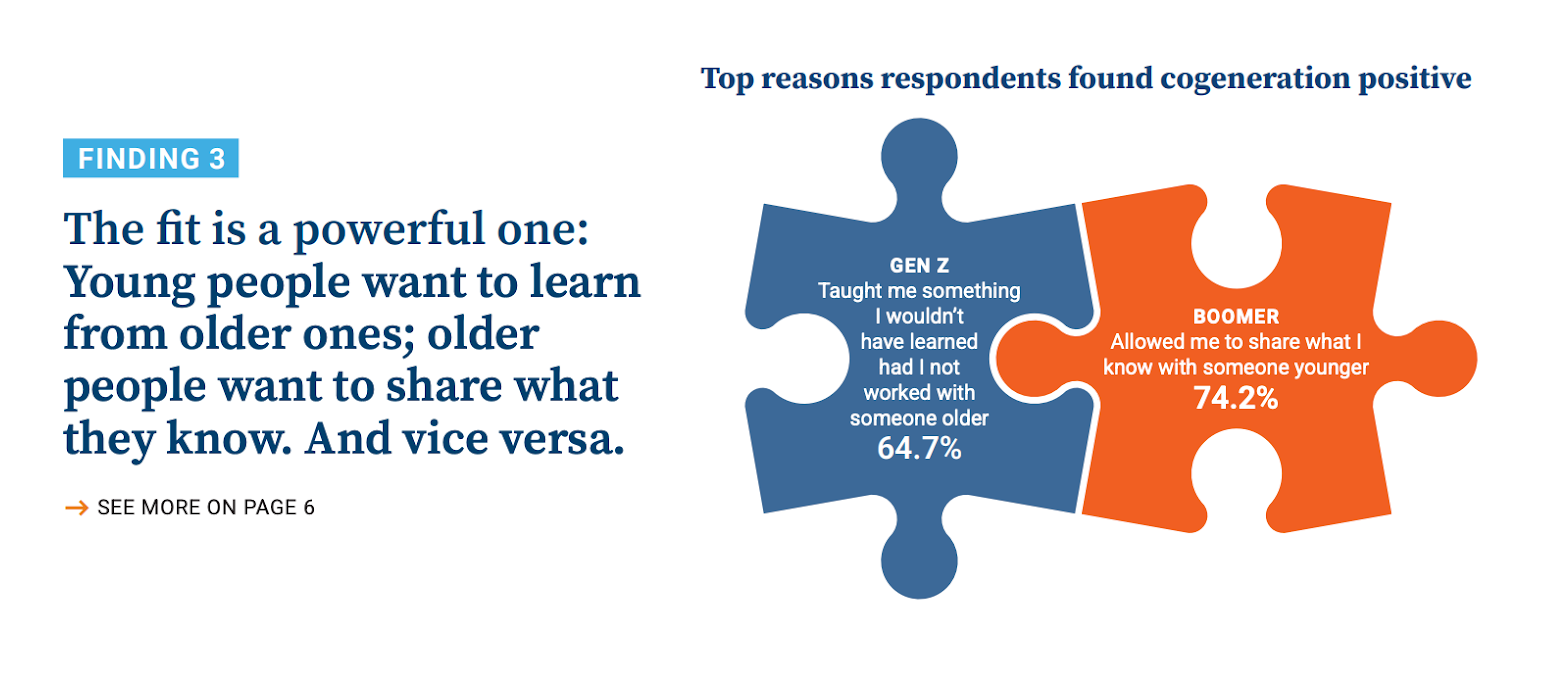
In March 2022, researchers at the University of Chicago surveyed over 1500 US residents aged 18 to 94, aiming to explore Americans’ views on intergenerational partnerships to address social problems, and “got a dose of clarity and optimism in return.” The resulting 16-page report is titled, “Is America Ready to Unleash a Multigenerational Force for Good?”
The findings paint a picture of pent-up demand. This is a solution wanting to happen. A sizable segment of the younger and older populations is hungry for opportunities not only for intergenerational connection, but cogenerational action — the chance to join forces in co-creating a better future.
Just as striking is where the strongest of that strong interest resides: in young people and people of color across the age spectrum. It’s no wonder that so many young people, growing up in diverse and multigenerational environments, would come so naturally to this direction. You can almost hear the next generation calling their elders to action, delivering the message that we can’t do this without you.
Three: Women Deserve Free Time
Over at the rightly-beloved Culture Study newsletter, Anne Helen Peterson asks, “What Makes Women Clean?”
If feminism is, at least in part, the radical notion that women are people, then part of letting go of clean culture is the radical idea that women – and not just white, bourgeois women – deserve free time. More specifically: free time unburdened by the feeling that they “should” be cleaning or parenting or meal prepping or doing laundry instead.
And Now, the Cute Kid Video of the Week
Time for some teenager appreciation. I’d tell you to hang in there for the sweet smile of triumph at the end, but it’s unnecessary because there’s no way you’re going to be able to look away from this one. In fact, I defy you to watch it only once.

Nothing Sold, Bought, or Processed
The Auntie Bulletin is an ad-free, feminist, anti-capitalist publication that will never try to sell you anything and donates 100% of revenue from Bookshop.org affiliate links to organizations supporting vulnerable kids.
If today’s post made you think or helped you out, please take a moment right now to become a paid subscriber. This newsletter is a form of carework and carework advocacy, and it’s how I make a living.
Thanks for reading all the way to the end! You get the secret scoop that if you can’t afford a paid subscription due to financial hardship, you can email me at auntiebulletin at gmail dot com and I’ll comp you a 12-month paid tier subscription, no questions asked.
[[1]]: Invoke Pokémon at your own risk. You may find yourself in a conversation from which you cannot escape. See also: Minecraft.